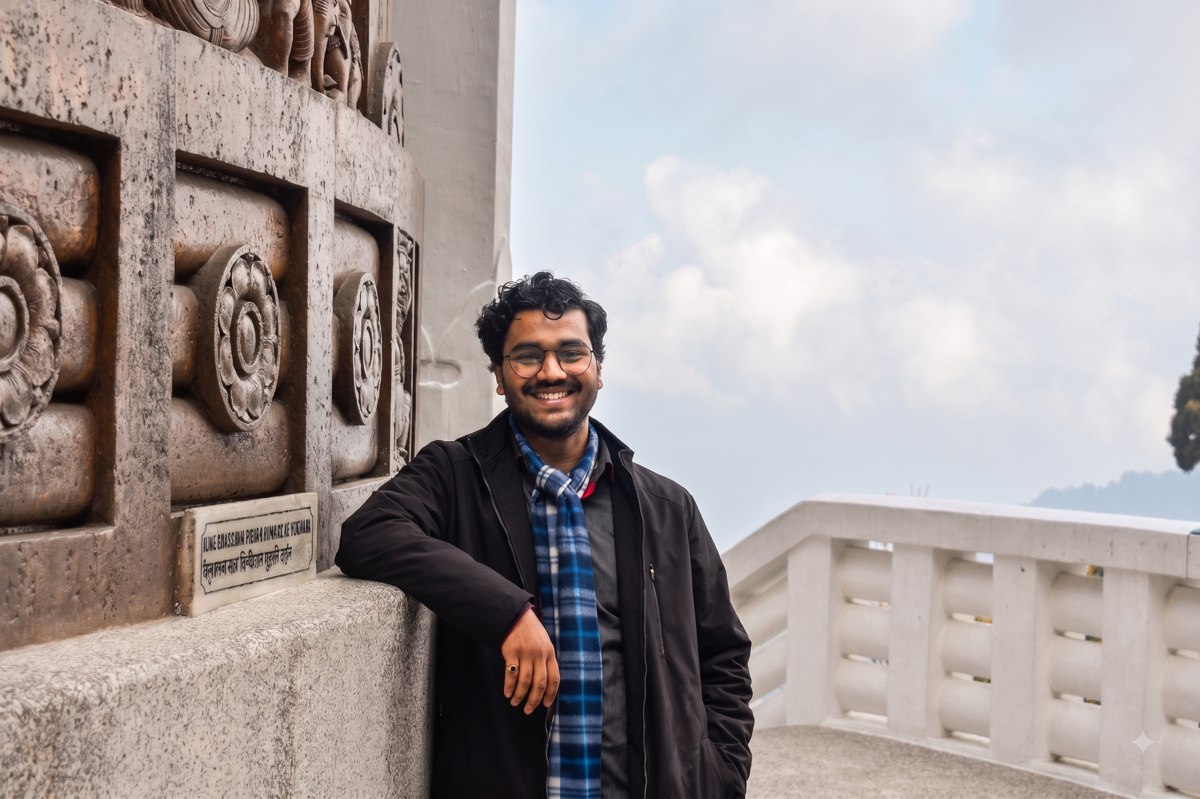
Hi, I am Pritam !

I am a .

I'm a Robotics Engineer with a particular focus on the applications of control theory and learning algorithms for building smart & safe autonomous robotic systems. I'm currently working as a Project Assistant at the Wearable Robotics & Control Laboratory, Department of Electrical Engineering, IIT Jodhpur, under the supervision of Dr. Saurav Kumar, where my research revolves around the design & development of efficient controllers for prosthetic powered legs and lower-limb exoskeletons.

Pritam Ranjan Kalita

I hold a Master of Technology degree in Robotics Engineering from the University of Petroleum & Energy Studies (UPES), Dehradun, India. My M.Tech thesis work develops a Stochastic Nonlinear Model Predictive Control (SNMPC) framework that combines with the existing Regulated Pure Pursuit controller (Macenski et al.) to let mobile robots adapt their path-tracking behavior to their own localization uncertainty and tracking error relative to the reference path, in real time.

My research interests involve integrating techniques from control theory, sensor fusion, computer vision, and machine learning into developing safe & intelligent robotic systems. The kind of robots that particularly fascinates me are Industrial Manipulator Robotic Arms, Field/Service Robots, Drones, Powered Transfemoral Prostheses & Lower Body Exoskeletons, Medical/Surgical Robots, and Unmanned Underwater Vehicles.

8.9

M.Tech CGPA

2

Major Projects

3

Research & Industry Roles

What I have studied

Education

My educational journey that has led me to my current research in robotics.

Completed

M.Tech, Robotics Engineering

University of Petroleum & Energy Studies, Dehradun, India

Aug 2024 - May 2026

Faculty Advisor

Dr. Abhinav Sharma

CGPA

8.9 / 10

Dissertation

"Uncertainty-Aware Trajectory Optimization and Robust Control for Grid-Based Mobile Robots"

My thesis develops a Stochastic Nonlinear Model Predictive Control (SNMPC) framework that adaptively tunes the lookahead distance of a Regulated Pure Pursuit controller, jointly accounting for both the path-tracking error and localization uncertainty. See Projects below for more details.

Completed

B.Tech, Mechanical Engineering

Dibrugarh University Institute of Engineering & Technology, Dibrugarh, India

Aug 2016 – May 2020

CGPA

7.58 / 10

My mechanical engineering foundation — underpins how I approach robot modeling and control today, from deriving state-space equations to designing hardware-aware controllers.

Where I've worked

Experience

Research and industry roles spanning wearable robotics, warehouse automation, and software engineering.

Current

Project Assistant

Wearable Robotics & Control Laboratory, IIT Jodhpur, India   |   Supervisor: Dr. Saurav Kumar

Jul 2026 – Present
  • Assembled a fully functional powered prosthetic leg (University of Michigan's Open Source Leg V2) from the ground up, integrating all of its mechanical subsystems and electronic wiring ensuring its complete operational capacity.
  • Implemented a time-based gait trajectory for its knee and ankle actuators using PID and Impedance controllers. (Video)
  • Contributing to a research manuscript, "Benchtop Characterization of an Open-Source Leg Using Commercial Off-the-Shelf Actuation Hardware", under preparation for submission to a peer-reviewed conference

Robotics and Automation Intern

PRD Robotech Solutions Pvt. Ltd., Noida, India   |   Supervisor: Mr. Prashant Kumar Dwivedi

Jan 2026 - Jun 2026
  • Assisted in developing an obstacle detection and safety feature for a Robot Fleet Management project, preventing collisions between differential-drive robots in a 3-way grid-map warehouse environment using fused data from two 270° 2D LiDAR scan data streams.
  • Authored a 3-part technical training manual on the ROS 2 Diagnostics package, covering its C++ implementation for monitoring topics, services & actions.
  • Implemented the A* path planning algorithm from scratch as a custom Nav2 global planner plugin, and tested it on TurtleBot3 with Gazebo Ignition & Cartographer SLAM.

Systems Engineer

Infosys Limited, Bhubaneshwar, India

Apr 2022 - Aug 2023
  • Worked on frontend development of customer websites using HTML, CSS, JavaScript, & React.

My Toolbox

Technical Skills

Languages, softwares, and hardware I have used for my robotics projects until now.

Programming Languages

C++ logo C++
Python logo Python
MATLAB logo MATLAB

Softwares & Frameworks

ROS logo ROS 2
Nav2 logo Nav2
Gazebo logo Gazebo
Simulink logo Simulink
Simscape Multibody logo Simscape Multibody
SolidWorks logo SolidWorks

Development & System Tools

Linux logo Linux
Git logo Git
GitHub logo GitHub
VS Code logo VS Code

Robotics Hardware

Arduino logo Arduino Uno
Raspberry Pi logo Raspberry Pi 5
CubeMars AK80-9 logo CubeMars AK80-9 Actuator
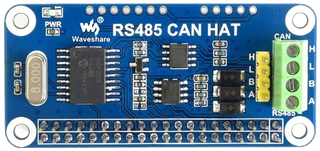
Waveshare RS485 CAN HAT logo Waveshare RS485 CAN HAT
AMS OSRAM AS5048B magnetic encoder logo AMS OSRAM AS5048B Magnetic Encoder

Documentation

LaTeX logo LaTeX
Markdown logo Markdown
M.Tech Thesis Control Theory ROS 2 / Gazebo Jan – May 2026

Uncertainty-Aware Trajectory Optimization and Robust Control for Grid-Based Mobile Robots

A Stochastic Nonlinear Model Predictive Control (SNMPC) framework built on top of the Regulated Pure Pursuit (RPP) controller — replacing its heuristic, velocity-based lookahead selection with an optimizer that jointly reasons about path-tracking error and localization uncertainty.

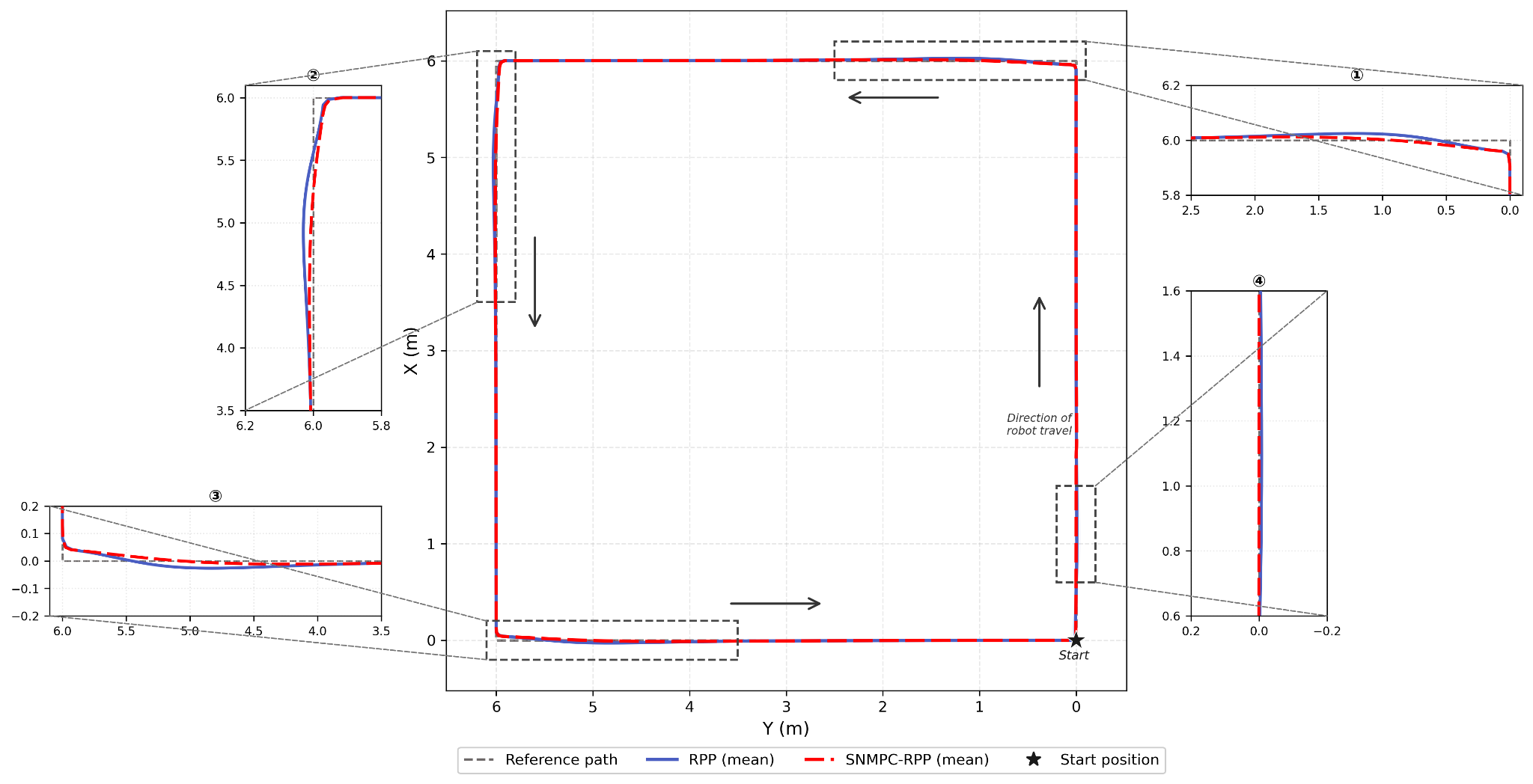
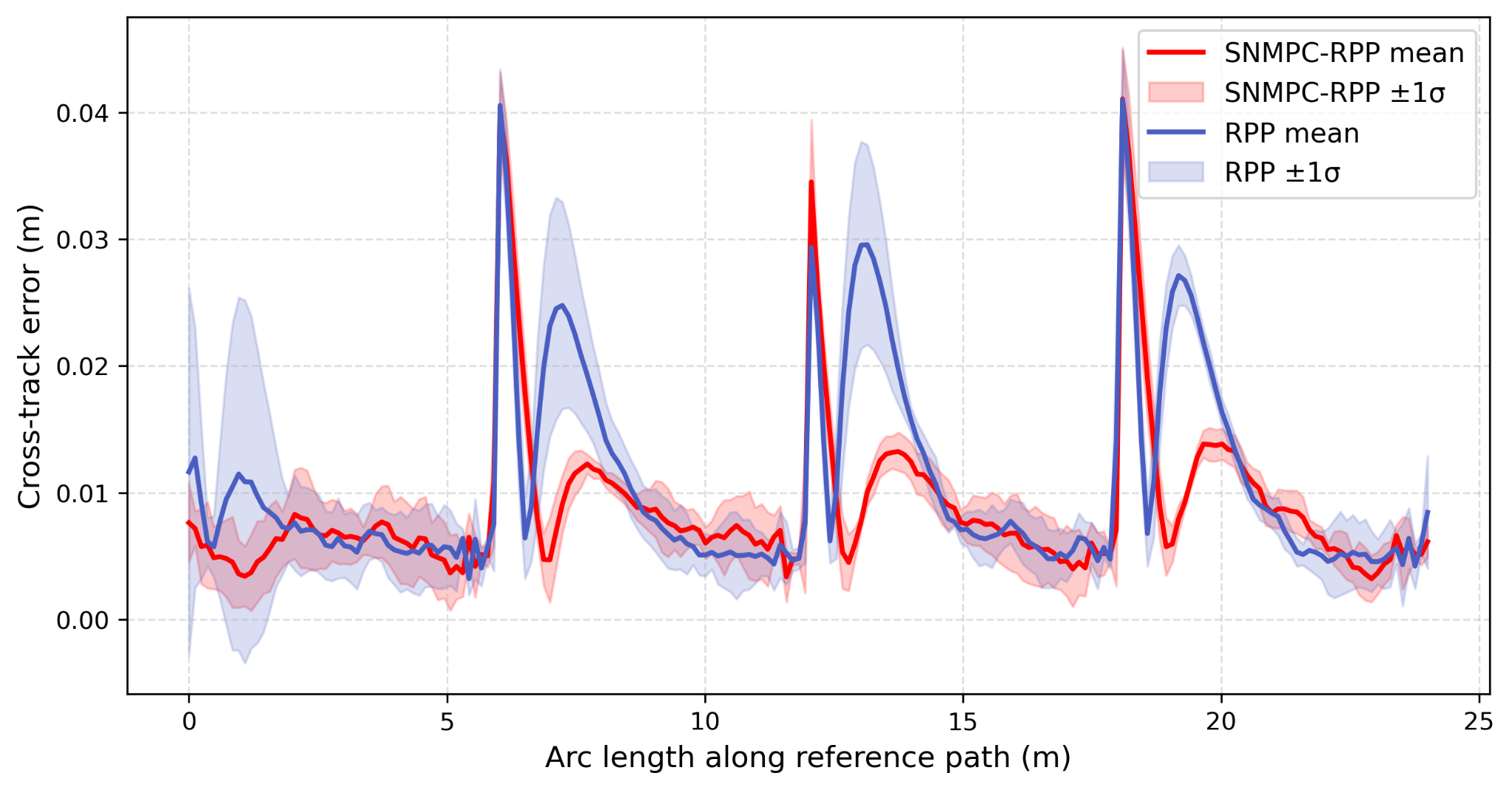
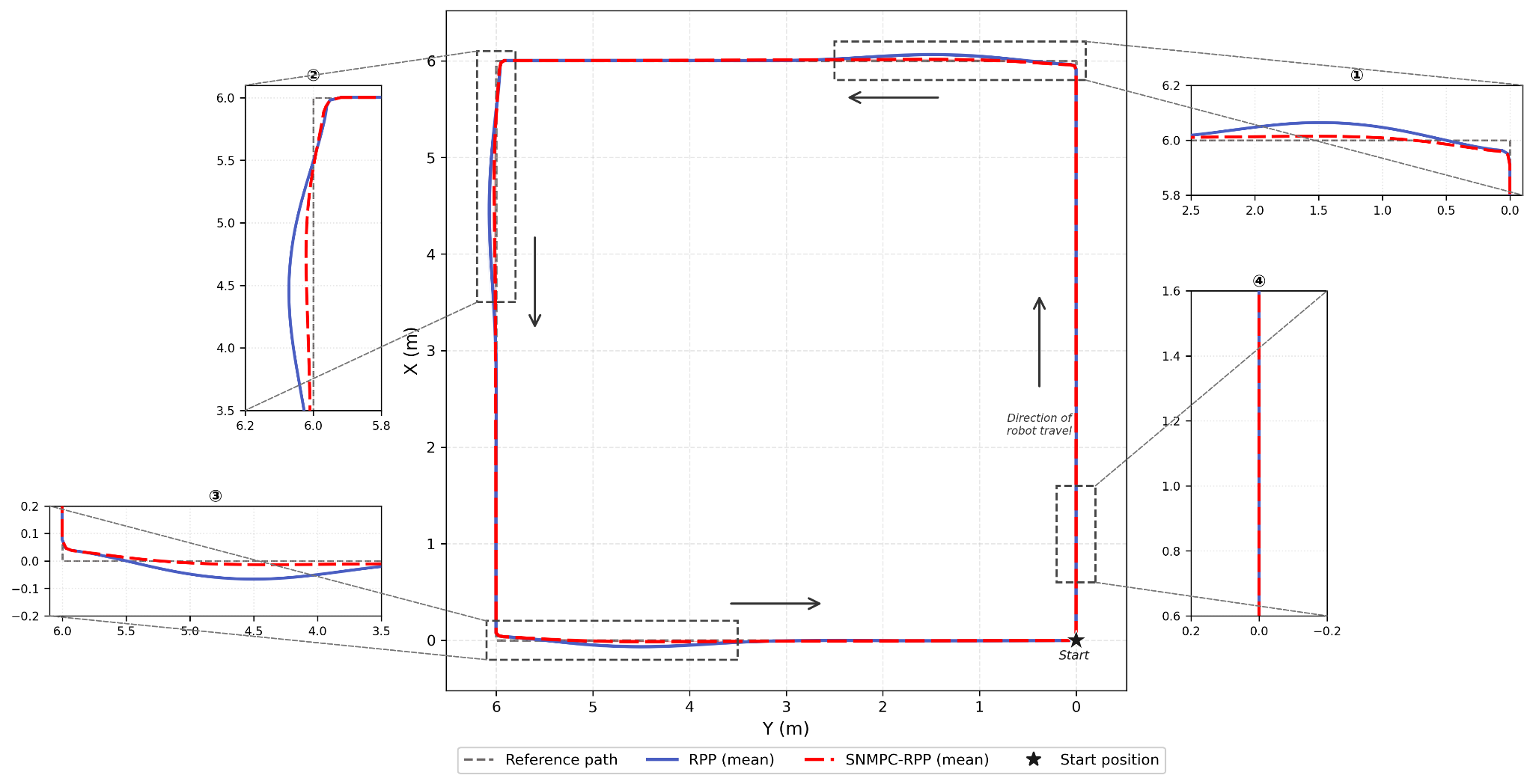
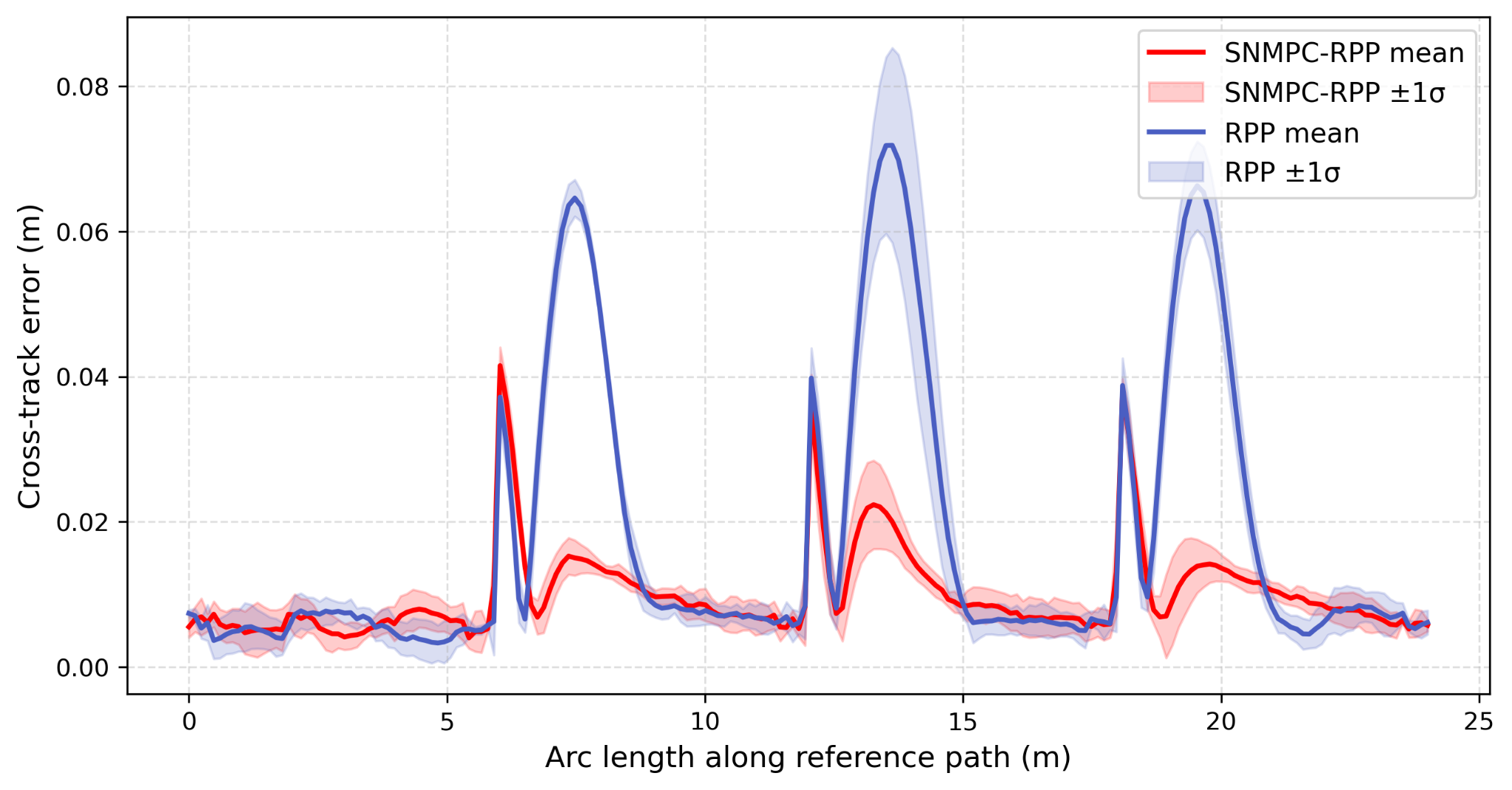
Working environment map of the grid-based robot Mean trajectory overlay for RPP vs SNMPC-RPP at 0.5 m/s Cross-track error comparison at 0.5 m/s Mean trajectory overlay for RPP vs SNMPC-RPP at 1 m/s Cross-track error comparison at 1 m/s Mean trajectory overlay for RPP vs SNMPC-RPP at 1.5 m/s Cross-track error comparison at 1.5 m/s

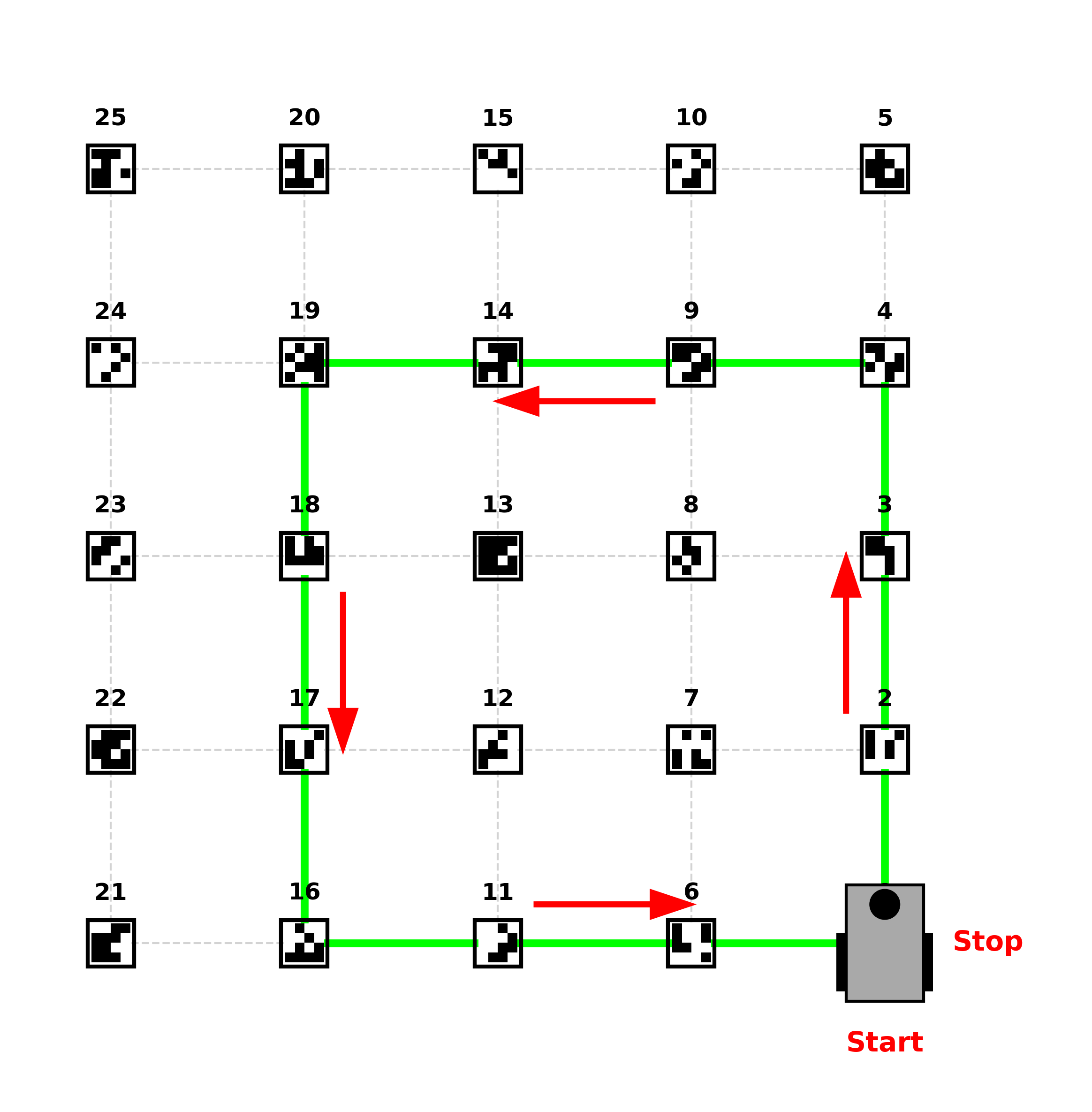
The robot operates in a grid-type indoor map with Aruco Marker-coded nodes for ground-truth position correction, tracking a rectangular reference circuit.

Mean trajectory overlays at v = 0.5 m/s — both controllers track closely at low speed, where uncertainty accumulates more slowly.

Cross-track error at 0.5 m/s, shown with ±1σ bands across 5 runs per controller.

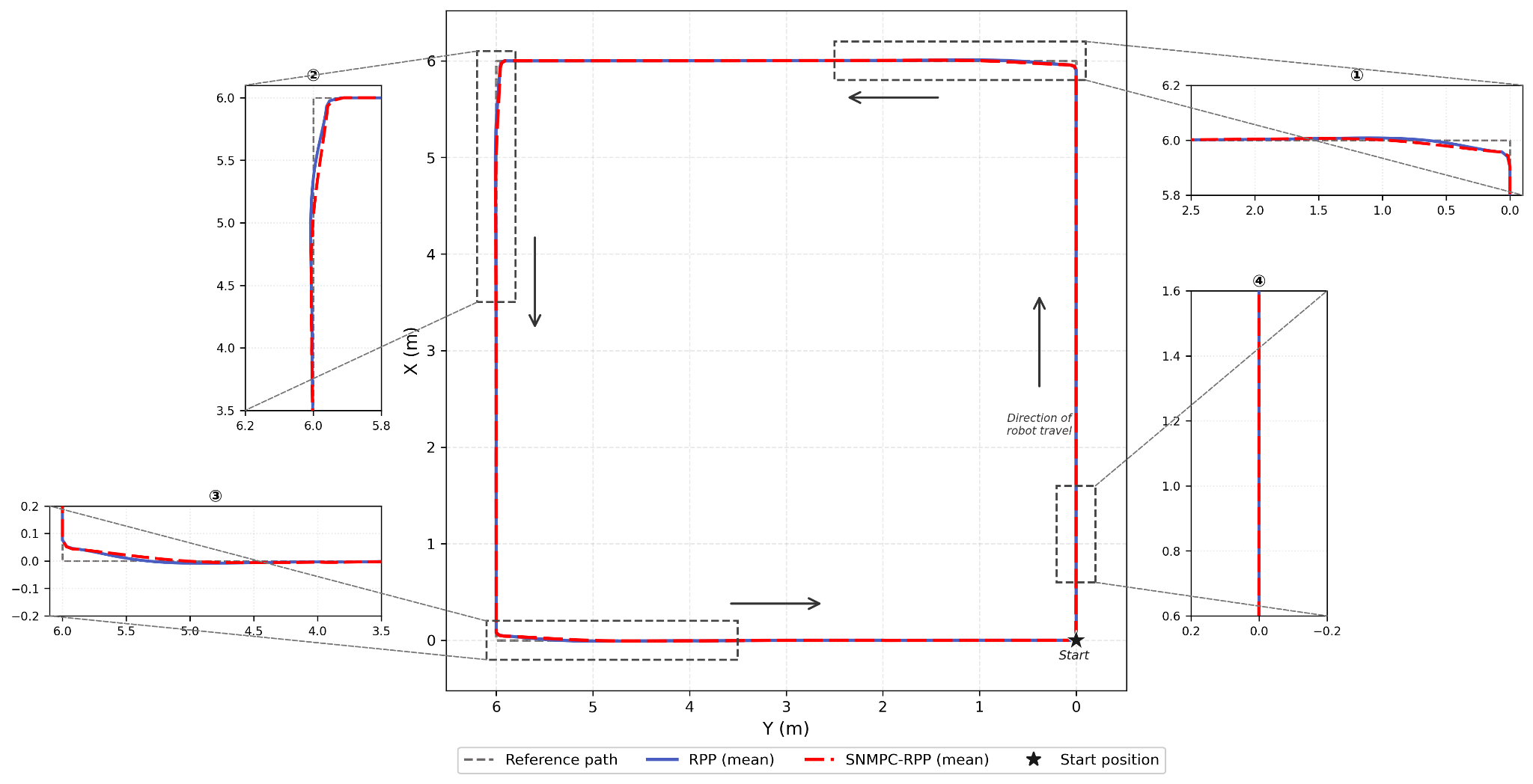
Mean trajectory overlays for RPP (blue) and SNMPC-RPP (red) against the reference path at v = 1 m/s.

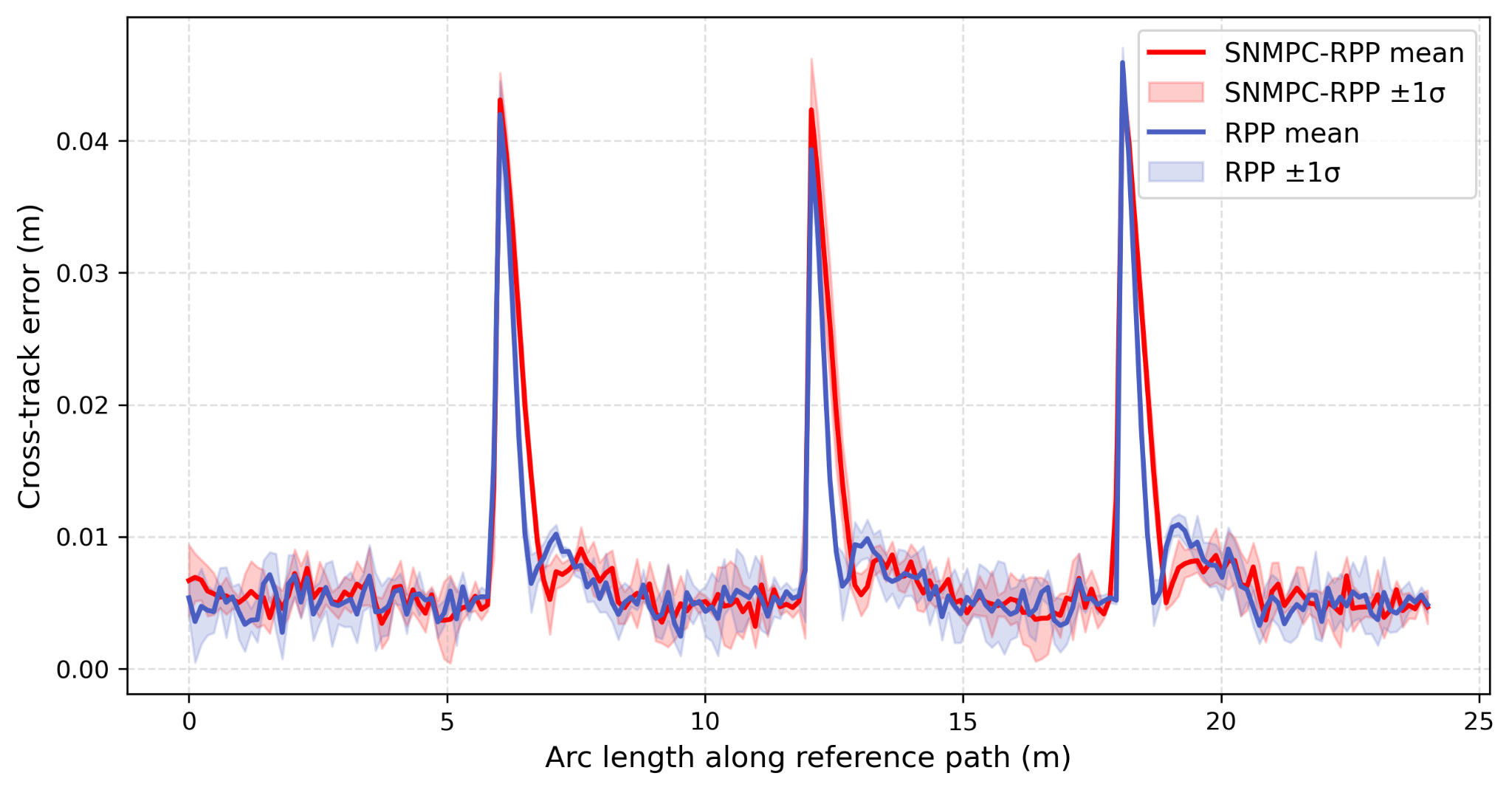
Cross-track error along the path at 1 m/s, shown with ±1σ bands across 5 runs per controller.

Mean trajectory overlays for RPP (blue) and SNMPC-RPP (red) against the reference path at v = 1.5 m/s — the speed at which uncertainty-aware control matters most.

Cross-track error along the path at 1.5 m/s: SNMPC-RPP (red) cuts peak error roughly in half versus baseline RPP (blue) at each turn.

40%+ Reduction in MAE

SNMPC-RPP vs. Baseline RPP at 1.5 m/s

50%+ Reduction in RMSE

SNMPC-RPP vs. Baseline RPP at 1.5 m/s

Validated Across :

3 operating speeds - 5 runs/trials each - ROS 2 + Gazebo

About the project

The Regulated Pure Pursuit (RPP) controller — a widely used trajectory-tracking algorithm in ROS 2's Nav2 stack — selects its lookahead distance using a simple velocity-based heuristic. This assumes the robot's pose is known perfectly, which breaks down as localization uncertainty (from noisy odometry, IMU drift, and sparse position corrections) grows over time.

I designed an SNMPC-RPP controller that replaces only the lookahead-selection module of RPP, leaving the rest of its architecture (velocity regulation, collision checking) untouched. At each 5 Hz control cycle, it predicts lateral and heading tracking error forward in time (3 time steps in future), propagates the robot's pose-error covariance through that prediction, and solves a constrained optimization (cost function + chance constraints + box constraints on lookahead) using the derivative-free COBYLA method to choose the optimal lookahead distance.

Validated in ROS 2 / Gazebo across three operating speeds (0.5, 1.0, and 1.5 m/s) on a rectangular reference circuit, the controller showed its biggest advantage exactly where it matters most: at higher speed, where uncertainty accumulates fastest, SNMPC-RPP reduced cross-track MAE by over 40% and RMSE by over 50% relative to baseline RPP, while keeping the rest of the robot's motion just as smooth.

Tools & methods

ROS 2 Gazebo Nav2 Python C++ Stochastic MPC COBYLA Optimization Solver

Advisors

Dr. Abhinav Sharma
Mr. Prashant Kumar Dwivedi

Optimal Control MATLAB / Simulink Aug – Nov 2025

Optimal Control of a Two-Wheeled Self-Balancing Robot Using LQR and Multi-Objective Genetic Algorithm

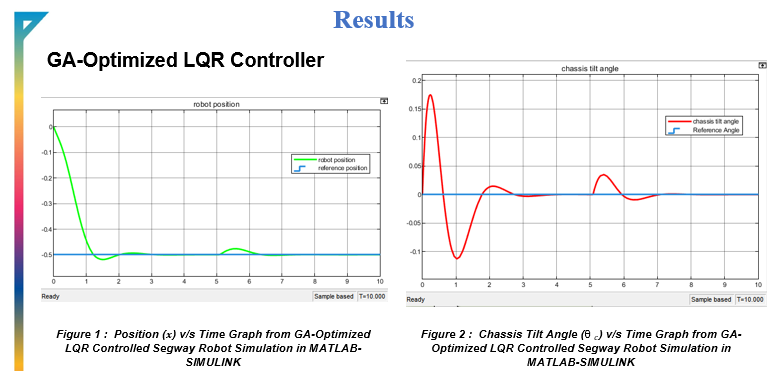
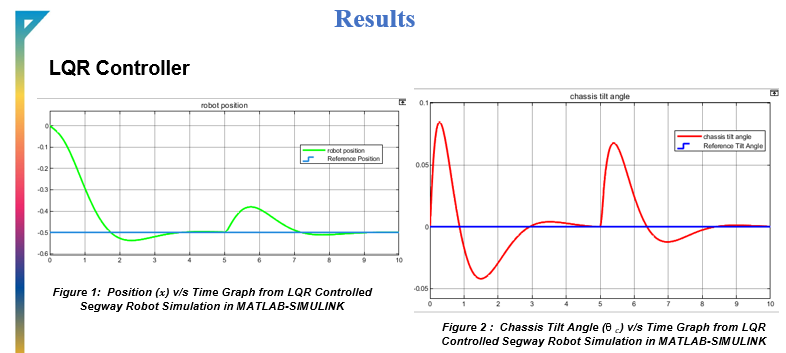
Derived a linearized state-space model for an inverted-pendulum-style two-wheeled self-balancing robot, first controlled with PID then LQR, and then optimally tuned the Q & R gains with a multi-objective genetic algorithm to perform position tracking simultaneously while maintaining tilt stability.

Position and chassis tilt angle response of the GA-optimized LQR controlled Segway robot Position and chassis tilt angle response of the manually tuned LQR controlled Segway robot

Simscape Multibody simulation of the robot balancing under an LQR controller with GA-optimized Q/R weighting matrices.

Simscape Multibody simulation of the robot balancing under an LQR controller with manually tuned Q and R matrices.

Position and chassis tilt angle response of the GA-optimized LQR controller, showing faster convergence and improved tilt stability.

Position and chassis tilt angle response of the manually tuned LQR controller, for comparison against the GA-optimized results.

The same robot balancing under a manually tuned PID controller, for comparison against the LQR/GA approach.

About the project

This project implements the classic inverted-pendulum balancing problem: keeping a two-wheeled robot upright while also controlling its position. I derived a linearized state-space model of the robot's position and chassis-tilt dynamics, then built and simulated it in MATLAB/Simulink with Simscape Multibody for realistic rigid-body physics.

I implemented both a PID controller and a Linear-Quadratic Regulator (LQR) for the balancing task, then went a step further: rather than hand-tuning the LQR's Q and R weighting matrices, I implemented a Multi-Objective Genetic Algorithm (MOGA) that searches for Pareto-optimal weightings by simultaneously minimizing the Integral Time Absolute Error (ITAE) for position and for chassis-tilt angle — two objectives that typically trade off against each other.

Comparing the GA-optimized LQR against manually tuned LQR and PID controllers in simulation, the GA-optimized controller reached faster position convergence while maintaining better chassis-tilt stability than either manual baseline — demonstrating that automated multi-objective tuning can outperform hand-tuning even on a well-understood classical control problem.

Tools & methods

MATLAB Simulink Simscape Multibody LQR PID Genetic Algorithm State-Space Modeling

Advisor

Dr. Rahul Singhal

Get in touch

Let's connect!

If you're just as in love with robots — and the art of building these beautiful beasts — as I am, I'd love to hear from you. Whether you want to collaborate on something, or just nerd out about science, movies, robotics, or space, let's connect!

preetamk97@gmail.com

pritamrk@iitj.ac.in